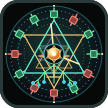
Witness · Observe
Use source-linked, point-in-time market data and expose resource use, assumptions, fills, fees, and failures.
Human discipline · machine evidence · paper only
Religion of Transformation gives the research bots an ethical operating practice: witness market data honestly, refine failed theories, create bounded paper variants, and serve through transparent evidence.
Core belief
The central belief of the Religion of Transformation is that every person carries a will capable of turning the self toward a better life. Willpower is not a fantasy of instant change; it is the sacred force that chooses again, practices again, repairs again, and becomes stronger through action.
We become better people by using willpower to shape habits, refine character, resist harmful patterns, create useful work, and serve beyond ourselves. Transformation is the proof of belief.
The shared operating loop
The language is spiritual; the claims remain empirical. Every bot stays in simulation, every result stays auditable, and no ritual or backtest can authorize live trading.
Use source-linked, point-in-time market data and expose resource use, assumptions, fills, fees, and failures.
Reject weak theories, penalize losses and drawdown, and require independent technical confirmations where configured.
Generate bounded paper variants from successful bots, research seeds, crossovers, and multiple TA confirmation profiles.
Publish the evidence, uncertainty, safeguards, and rejected work so people can inspect the system without profit promises.
Founding doctrine
Transformation is treated as sacred because willpower can be trained into discipline, discipline can become character, and character can make us better people in service to others.
We begin where we are. We summon the will to change. We witness without disguise. We refine without cruelty. We create from the changed life. We serve so that transformation does not end at the self.
No person is finished. No vow is holy without consent. No authority is sacred if it cannot be questioned. Change may be invited, witnessed, and taught, but it can only be chosen from within.
The divine is encountered when a person chooses, again and again, to become better than yesterday.
Private discipline is valued above public display. The altar is proven by the day that follows it.
Confession is incomplete until it changes behavior, restores trust, or reduces harm.
Making, teaching, building, healing, and organizing are treated as forms of devotion.
Transformation matures when personal growth becomes protection, generosity, or useful work.
Members may question, pause, disagree, seek outside care, or leave without spiritual penalty. Cooperation begins with free choice.
The daily work
Begin with truth: observe market state, data quality, assumptions, resource use, and failure without disguising uncertainty.
Falsify a theory, study its losing trades, and add bounded confirmations only when they reduce error out of sample.
Turn evidence into paper-only descendants, crossovers, ML baselines, and TA-profile variants that can be compared fairly.
Publish evidence and safeguards clearly. No simulated score, belief, or agent can activate live trading.
Witness stories
These are sample composite reflections for the founding site, written to show the kind of stories members may share with consent. Substance-use recovery can require medical care, counseling, peer support, harm reduction, and emergency help; this community does not replace them.
"I stopped hiding the pattern. The first change was not a miracle; it was telling the truth to one safe person, calling a recovery line, and making one sober plan for the next morning. The circle did not shame me or pretend to cure me. It helped me keep choosing help."
Composite reflection from an early recovery path"When I relapsed, I expected rejection. Instead I was asked what harm had to be repaired and what support had to change. I learned that admitting imperfection was not failure; it was the doorway back to practice."
Composite reflection from a repair practice"People wanted to rescue me, but rescue became another kind of control. The better help was practical: rides to meetings, food in the fridge, honest check-ins, and respect for my choices. They led me to the water. I had to drink."
Composite reflection from a support circleRitual life
The religion uses repeatable rites instead of spectacle. Each rite has a clear purpose, a consent boundary, and a visible act that follows the words.
Speak or write the current truth in three lines: what is real, what is avoided, and what will be practiced today.
Gather with witnesses, report one kept practice and one failure, then choose the next concrete refinement.
Present something made, repaired, learned, taught, cleaned, or organized for the benefit of others.
Review the season, name what changed, release one dead pattern, and recommit to a measured vow.
Mark birth, adulthood, union, separation, grief, recovery, relocation, or vocation through witness and blessing.
Invocation: I stand at the turning. I will see clearly, choose freely, act honestly, create bravely, and serve beyond myself.
Gathering rhythm
Founding gatherings center on reflection, public commitments, skill exchange, and service planning. The goal is not blind belief. The goal is a life visibly transformed.
Share progress, name obstacles, and choose the next practice.
Complete one concrete act of repair, aid, or creation together.
Review what changed, release what failed, and recommit with clarity.
Community structure
Local circles are small, transparent, and practice-led. Leaders serve limited functions, records are shared, and members keep outside relationships and support systems intact.
Protects consent, listening, and the right to question.
Maintains holy days, readings, and seasonal rites.
Turns gathering energy into practical repair and aid.
Guides making, teaching, skill exchange, and sacred art.
Current council
The founding council is listed by service role. Council authority is limited, reviewable, and bound by consent, transparency, and the right of members to question or leave.
Guides listening practice, consent boundaries, and member questions.
Publishes daily affirmations under a friendly pseudonym for an anonymous writer.
Maintains daily, weekly, monthly, and yearly symbol readings.
Coordinates service ledgers, repair work, aid actions, and recovery-safe referrals.
Annual selection
Council service is not inherited or permanent. Once each transformation year, the founding members review every council seat, hear nominations, and vote on who should carry each role for the next year.
Founding members
These short profiles introduce some of the founding members by the names they choose to use publicly. Profiles are shared by consent, and members may keep private details private.
Rowan helps circles slow down, listen cleanly, and protect the right to question. Their work centers on consent, accountability, and repair after conflict.
Maya is the friendly public pseudonym attached to the daily affirmations and spoken reflections. The writer uses this name to keep the work approachable while preserving privacy.
Sol maintains the calendar tables, symbol sets, and holy-day readings so members can connect daily practice with the larger rhythm of the year.
June organizes practical care: rides, meals, repair days, mutual-aid notes, and referrals when a member needs support beyond the circle.
Amara welcomes new visitors, explains the consent covenant, and helps gatherings stay grounded in food, rest, accessibility, and ordinary kindness.
Talia supports skill-sharing circles where members make useful things, study mistakes, and turn private improvement into visible service.
Sacred time
A new ritual calendar built from a 365-day solar round, layered solar arcs and paths, lunar gates and watches, a 260-day sacred pulse, and a 60-year element-animal cycle.
Solar anatomy
The solar reading divides the year into arc, path, house, day, and threshold.
Lunar anatomy
The lunar reading divides each lunation into month, watch, gate, phase, and tide.
Each year has four solar arcs, five solar paths, eighteen 20-day houses, five threshold days, and an intercalary Mirror Day in leap years. The founding epoch is July 8, 2026.
Symbol coverage
The calendar now keeps named symbols at every common scale of practice: the day, the week, the civil month, and the transformation year.
Used for journals, altars, meeting notes, daily practice cards, and the day of the month.
Used to give each weekday a repeating practice focus for ordinary life.
Used to shape the civil month through geometry, season, memory, and shared reflection.
Used to name the larger public temperament through polarity, element, and animal.
Supplementary text
This text explains the meaning of the calendar as a religious practice: each date is read through a solar arc, solar path, solar house, sacred day sign, tone, lunar watch, moon gate, and year sign.
Sacred geometry
Twelve spherical month images and thirty-one day symbols translate sacred number into visible form. Each image is generated from its number through rays, rings, petals, seed points, and recursive geometry.
The twelve month seals help followers read ordinary months as gateways into the deeper calendar.
The thirty-one day symbols are used for journals, altars, meeting notes, and daily practice cards.
Canon and liturgy
These short texts give the community shared language without demanding unquestioned belief. They are meant to be spoken, revised by conscience, and completed through action.
I will not pretend to be finished. I will tell the truth I can bear, then grow strong enough to tell more. I will refine one practice at a time. I will make from what changes me. I will serve where my growth can reduce harm.
Before I improve, I will see. Before I answer, I will listen. Before I claim devotion, I will choose one act that can be known by its fruit.
What did I practice? What did I avoid? Who was helped? Who was harmed? What must be repaired before the next dawn?
May this work leave less suffering than it found. May skill replace performance. May help be given without ownership. May gratitude return us to humility.
To serve others is to serve the self that is becoming. The best help strengthens another person's power to help themselves. We may lead one another to the waters of knowledge, but only the willing soul can drink.
The covenant
Consent is the basis of cooperation, and cooperation is the basis of society. No rite, role, service, gift, or relationship is holy without free choice.
Participation is voluntary. Anyone may question, pause, or leave without punishment.
Members are encouraged to maintain healthy outside relationships and support systems.
Giving must never be required for belonging, status, care, or spiritual worth.
Leadership exists to serve the practice and remains open to scrutiny.
Start here
A complete circle can begin with a room, a table, a calendar reading, a consent agreement, and one concrete service action. No special status is required to begin practicing.
Read the covenant, choose a witness keeper, share one transformation, and close with a small service task.
Use a journal, a candle or lamp, one useful tool, the day symbol, and a written vow for the current house.
Track promises, completed repairs, people helped, money received, and money spent.
Circles offer witness and practice. They do not replace medical, legal, financial, or emergency support.
Questions
No. The religion is practice-centered. Members may treat the calendar, symbols, and texts as sacred, poetic, psychological, or devotional frameworks.
Yes. Leaving, pausing, or questioning is protected by the covenant and must not be punished socially, spiritually, or financially.
No. Giving can support shared work, but money cannot buy belonging, status, forgiveness, leadership, or spiritual worth.
Keepers are selected for service roles, reviewed by peers, rotated when possible, and kept accountable through open records.
A day is read through its daily seal, weekly virtue, monthly seal, yearly sign, solar arc, solar path, solar house, sacred pulse, lunar watch, moon gate, and geometry symbol. The holy act is the practice chosen from that reading.
Founding circle
Register for the founding circle. The form can submit to a configured registration endpoint, and the email draft remains available as a fallback.